Showing posts with label Extinction. Show all posts

Monday, 27 June 2016

Threats to Sharks

Because they are very slow to reach reproductive age, sharks have great difficulty recovering their populations after extreme depletions. Despite their superior physiology and hunting skills, many shark species are now threatened with extinction. Of the 465 assessed species of sharks living in our oceans, 74 are currently listed as threatened (including 11 species which are critically endangered) on the International Union for Conservation of Nature (IUCN) Red List. The IUCN has estimated that one quarter of all shark, ray, and chimaera species are threatened with extinction.

Sharks are unfortunately disappearing at an alarmingly fast rate due to several threats. In a study conducted by Oceana, researchers estimated that as many as 100 million sharks are still caught and killed worldwide due to bycatch, illegal fishing, and the demand for shark fins. This makes it extremely difficult for endangered sharks to survive.

BYCATCH
Bycatch is the accidental capture of non-target fish and other marine life, and occurs in fisheries around the world. When lines are unattended, such as in some longline fisheries, the toll can be particularly high. The species that are most at risk include dusky sharks and scalloped hammerheads. Dusky shark populations off the Atlantic coast has declined by 85 percent. Scalloped hammerheads are extremely susceptible to fishing mortality due to their uniquely shaped and sensitive bodies.

ILLEGAL FISHING
Oceana reports that up to 24 countries may be catching sharks within the Atlantic and Mediterranean Sea without reporting such catches. Commercially-caught species like mako and blue sharks are fished without any restrictions.

SHARK FIN DEMAND
The international fin trade is one of the greatest threats to shark species. It is a wasteful and harmful practice in which only two to five percent of the shark is even used — once a shark's fins are cut off at sea, the shark is tossed back into the water to drown.

RECREATIONAL FISHING
The impact of commercial fishing on shark populations is astonishing. Recreational fishing for sharks is popular in many places and species targeted are blue sharks, shortfin mako, porbeagle, and thresher sharks.

HABITAT LOSS, POLLUTION AND ENVIRONMENTAL DEGRADATION
Coastal development has increased significantly which has altered habitats, increased levels of pollution and resulted in the general environmental degradation. Many shark species use inshore coastal and estuarine habitats as a safe place for finding food, giving birth and growing up away from predators and competitors. Thus, they are vulnerable to negative changes in their habitat.

Sharks are susceptible to pollution (filtered from land activities or directly deposited into the seas) and environmental contamination. As apex predators with very slow growth, they accumulate the pollutants and toxins in the environment and bioaccumulating all the toxins of their prey.

REFERENCES
http://www.defenders.org/sharks/threatshttp://shark-facts.com/
http://oceana.org/blog/what-are-some-biggest-threats-facing-sharks
http://www.sharksavers.org/en/education/sharks-are-in-trouble/other-threats-facing-sharks/

Great White Shark

Source: Kids Konnect
Other names for this lethal predator include: White Death, Great Pointer or White shark.

Kingdom          Animalia

Phylum            Chordata

Class                Chondrichthyes

Subclass           Elasmobranchii

Superorder       Selachimorpha

Order                Lamniformes

Scientific Name Carcharodon Carcharias

Type                Fish

ANATOMY
Source: NSW Government
It is well-known for its size, reaching upwards of 6.4m (21 ft) in length. Females are larger than males. Their weight limit is approximately 3,000 kg (7,000 lb). It is the fourth largest shark, following the megamouth shark, the basking shark and the whale shark.

It's famous for its dark to light grey upper body and all white lower half. To a seal swimming on the surface, the shark would resemble the murky depths below it and if seen from below, the stark white belly would resemble the light from above, known as countershading.
Source: Mirror UK

It has a long pointed conical snout, similarly sized upper and lower lobes of the tail and a mouth filled with serrated teeth. The jaws of the sharks are lined with rows of teeth just beneath the gum. It is composed of nearly pure muscle, with very little fat. It stores fat in the liver for emergency use or for travelling long distances without eating.

BEHAVIOUR
The Great White’s behaviour is not well known. But some have been found to have bites matching other Great Whites, suggesting that a proximity warning is given with a light bite. Spy hopping is frequently done as the shark breaks the surface of the water and looks above the ocean for prey. Research suggest that it has to do with smelling for prey, as smell travels faster through air than water.

They also breach whereby they, usually while attacking, charge from below the prey at up to 40kmph (25mph). This results in huge sharks breaking the surface of the water while grabbing the prey, flying up to 3 m (10 ft), above the water.
 
Source: The Animal Globe
DIET
They are carnivorous, preying on nearly any fish in the ocean, but preferably fat rich animals. Juvenile (younger than 15) sharks hunt and eat small fish because the cartilage in their jaws isn’t mineralized to withstand the force for a stronger bite. Older sharks are able to hunt larger prey, such as elephant seals, sunfish and even whales. They also scavenge food, consuming off the dead carcasses of, for example, whales. This particular species is warm-blooded and although it doesn’t keep a constant body temperature, it needs to eat a lot of meat to regulate its temperature. 

HABITAT & DISTRIBUTION
Their distribution is widespread, found in every ocean and sea across the world. They are commonly found as far north as the Upper Atlantic and Pacific, just south of Arctic waters and as far south as the southern tip of Australia. The Great White is considered native to the Mediterranean states, United States, sub-Saharan coastal states, South America and the Australian states. They stay close to coastal shelves, preferring to hunt off the coastline. They spend their time in temperate waters all over the world, but have made fleeting trips into colder water in the north.


Source: Animal Fact Guide
REPRODUCTION
Sharks reach reproductive maturity at 15 years. Females are ovoviviparous (they hatch their eggs internally then give birth once their pups are strong enough). Pups are oophagous (they eat the weaker eggs while gestating). After mating the female develops several eggs which hatch in her womb. They give birth between spring and summer and have specific breeding grounds. They have anywhere between 1-5 pups. Pups are roughly 1 ft. long when they are born and weigh around 5kg. Their jaws are strong enough to kill within their first month of life.

CONSERVATION STATUS
Their numbers have steadily declined, though there is no exact number of population size. According to the International Union for the Conservation of Nature, their status is currently Vulnerable but it is on the cusp of being labelled endangered due to overfishing.


Source: HD Desktop Wallpapers
REFERENCES
http://www.animalfactguide.com/animal-facts/great-white-shark/


Shoutout to SHARKS

INTRODUCTION

Source: Shark Facts
It is indisputable that sharks are some of the most majestic creature of the marine world. Sharks are an apex predator and they are at the top of the marine food chain and, consequently, regulate species populations that are below them. Sharks have been around for 400 million years (pre-dating dinosaurs and even trees). Their Conservation Status is Threatened. Frequently there is a misconception about them. Although they still remain dangerous species, attacks on humans are more commonly rare and they are far more scared of than we could ever be of them. There are more than 465 known species of sharks in our oceans. More worrisome is the fact that shark populations have declined considerably and has cascading effects throughout the ocean’s ecosystems. In fact, they are amongst the most threatened marine vertebrates on Earth, with some species facing extinction as they face numerous human threats.

Kingdom                      Animalia

Phylum                        Chordata

Class                            Chondrichthyes

Subclass                       Elasmobranchii

Scientific Name           Selachimorpha

Type                             Fish

ANATOMY
Source: Wikipedia
It features include a torpedo-like body shape, large distinctive dorsal fin and gaping tooth filled jaws. They are highly sophisticated. Their general anatomy is fairly consistent in all the various species.

Sharks boast five to seven gill slits on the sides of the head, unlike most fish that only have one gill. They rely on a large oil filled liver for buoyancy and takes up around 30% of their total body mass, using it in conjunction with forward movement to control vertical position.

Skeleton
Chondrichthyes have skeletons made up of cartilage rather than bone, and lack a swim bladder. Cartilage is lighter, more durable, and flexible than bone, contributing to their overall agility whilst also saving energy. This is vital when sharks must constantly move to prevent sinking.

Jaws
Sharks have powerful jaws. The jaws of sharks are not attached to their skull. It moves separately with independent upper and lower jaws, allowing them to lift their head and thrust their mouth forward to bite its prey. The surface of shark’s jaws have extra support in the form of tiny hexagonal plates called ‘tesserae’ – calcium salt deposits which give shark cartilage more strength.
Source: Kidzone
Teeth
Their teeth are sharp and pointy. Sharks may have up to 3,000 teeth at one time and are fully embedded into the gums. A shark bites with its lower jaw first and then its upper.  Each type of shark has a different shaped tooth depending on their diet. Interestingly, sharks never run out of teeth – they continuously grow multiple rows of replacement teeth in a groove inside of the jaw, and are usually replaced one at a time as opposed to entire rows. It is estimated that some sharks may lose 30,000 or more teeth in their lifetime, with replacement rates varying from several days to several months.

The shape and size of the teeth vary depending on their purpose. There are four main types of shark teeth:
·         Needle-like teeth are found in sharks whose diet consist of small to medium sized fish and are effective at gripping onto agile and slippery fish.
·         Serrated, wedge like teeth are found in larger species that feed on larger prey. It is effective at cutting off chunks of flesh for easy swallowing.
·         Teeth which serve no purpose are found in plankton feeders (for example the basking and whale shark who uses their gills to filter feed).
·         Dense, plate like teeth are used to crush the shells of prey (for example bivalves and crustaceans). Includes smaller sharks like nurse or angel sharks.

Fins and Tails
The majority of sharks have 8 rigid fins:
A pair of pectoral fins that lift the shark as it swims
One or two dorsal fins offering stability
A pair of pelvic fins offering stability
An anal fin offers stability
A caudal fin (tail) that propels the shark forward

The shark’s tail provides its forward motion, with speed and acceleration dependent on shape and size. Some tails have large upper lobes for slow cruising with short and sudden bursts of speed, whereas others have larger lower lobes for continued pace.

Skin
Their skin is made of denticles and not from ordinary fish scales and act as an outer skeleton for easy movement and for saving energy in the water. It is constructed like hard, sharp teeth and help to protect the shark from injury. Sharks wounds heal quickly.

The upper side of a shark is normally dark to blend in with the water from above and their undersides are white or lighter coloured to blend in with the lighter surface of the sea from below which helps to camouflage them from predators and prey.

SIZE
Their size vary from 17cm (Spined Pygmy Shark) to 12 metres (Whale Shark).

DIET
Most shark species are carnivorous. The range of prey is exceptionally broad, including small bivalves, crustaceans, plankton, krill, marine mammals, and even other sharks (for example, a tiger shark might eat a bull shark, a bull shark might eat a blacktip shark and a blacktip shark might eat a dogfish shark). Generally sharks eat live prey, but have been known to feed on large whale carcasses. Sharks also have a very acute sense of smell that allows them to detect blood in the water from miles away. The gentle giants (for example the whale and basking shark) feed on plankton, filtering the water and trapping small organisms with sieve-like filaments. Sharks eat normally alone, but sometimes one feeding shark attracts others and all begin to try to get a piece of the prey. Some shark species attack and surprise their prey (such as seals and sea lions) from below.

HABITAT
Source: Animal Fact Guide
Sharks occur in all seas and have adapted to living in a wide range of aquatic habitats and varying temperatures. Some species inhabit shallow, coastal regions, others live in deep waters, on the ocean floor and in the open ocean. They mostly avoid fresh water. An exception is the bull and river sharks that swim between sea and fresh water. They are normally found to a depth of 2,000 meters, with some existing even deeper. ‘Pelagic’ sharks (for example the Great White) prefer large open waters. ‘Benthic’ sharks (including the wobbegong) are seen skating along the ocean floor. Typically, sharks are confined to their suited habitat for their whole lives. But some migrate short distances or entire oceans for feeding or breeding purposes.

BEHAVIOUR
Only a few species are solitary hunters (including the great white) but, they too, often coexist at active hunting or breeding grounds. Most execute a range of social behaviour, hunting in packs or congregating in large numbers. Sharks characteristically cruise at an average speed of 8km per hour because they need to move in order to breathe. This forces water over their gills, delivering oxygen to the blood stream. Conversely, some shark species have adapted to benthic living, resting on the sea bed, and pumping water over their gills. Interestingly, they never enter a true state of sleep. Their eyes remain open and even track the movements of their surroundings during periods of inactivity. Some species are even able to ‘sleep swim’ by being unconscious while meandering around the ocean as a result of swimming being coordinated by their spinal cord and not their brain. Most sharks are particularly active at night when they hunt. Some shark species are solitary, while others display social behaviour. For example, hammerhead sharks school during mating season around seamounts and islands.

SENSES
Source: Animal Fact Guide

Sharks have excellent senses. Two-thirds of a shark's brain is dedicated to its smell sense. They are able to detect a drop of blood from very far away and it gives them the ability to determine the direction of a particular scent based on the time it takes to reach one nostril compared to the other. Their nostrils are primarily used for smelling (as opposed to breathing) and are located on the underside of their snout.

Furthermore, they have great eyesight. New research shows that sharks may be colour-blind. A mirror like layer in the back of the eye called the tapetum lucidum doubles the intensity of incoming light and allowing them to see remarkably well in dim conditions. They don’t blink, even though they have eyelids. They rely on surrounding water to clean their eyes. When hunting or being attacked, some sharks have tough membranes that slides over and protects the eyes. Species that don’t have this membrane, roll their eyes backwards when striking prey.

Sharks do have ears which are located within a small opening on each side of their head, but it isn’t visibly present. Sound travels faster in water and sharks rely on it to alert them to prey or danger which can detected from over 800 feet away.

They are able to feel vibrations in the water using a line of canals that go from its head to its tail and are filled with water and contain sensory cells with hairs growing out of them. These hairs move when the water vibrates and alerts it to potential prey. Sharks also have a sensory organ called the "ampullae of Lorenzini" which they use to "feel" the electrical field coming from its prey.

REPRODUCTION
Sharks mostly live 20-30 years. They mature slowly and reach a reproductive age from 12 to 15 years. Sharks are a k-selected species (they produce a small number of larger, more developed young), resulting in a relatively high survival rate. Nevertheless, mating between sharks is still rarely observed, especially between the larger species such as the great white. Many species only give birth to one or two pups at a time and have difficulty recovering after their populations have declined.
 There are also different ways that sharks come into this world, including: eggs are laid (like birds); eggs hatch inside the mother and then are born; and pups sharks grow inside the mother (like humans).
 

Source: Arkive
Baby sharks are called pups. Shark pups are born with fully-fledged sets of teeth. Sharks don’t care for their babies after they are born, but they do search for a safe place where they can lay their eggs or give birth. Soon after birth, they swim away to feed and live on their own.

POPULATION
It is problematic to estimate population numbers since there are many dissimilar species spanning a large geographic area. But it is undeniable that overall shark numbers are on the decline due to several threats they face in the wild. Their lifespan is about 20-30 Years in the wild.

REFERENCES
http://animals.howstuffworks.com/fish/sharks/shark6.htm


Tuesday, 21 June 2016

Facts about Giraffes

·       The name Giraffe Camelopardalis means ‘one who walks quickly, a camel marked like a leopard’.

·       The giraffe is the tallest mammal in the world - at an average height of around 5 m (16-18 ft.).
 
Source: Travelblog
·       It is characterized by its long legs, long neck, and distinctive spotted pattern.

·       No two giraffes have the same spot pattern.

·       The distinctive spots on their fur is a good camouflage to protect the giraffe from predators. When they stand in front of trees and bushes the light and dark colouring of its fur blends in with the shadows and sunlight.

·       When giraffes walk, they move both legs on one side of their body and then both legs on the other side.

·       Their height helps it to keep a lookout for predators across the wide expanse of the African savanna.

·       A giraffe’s neck is 1.5 – 1.8 metres and contains the same number of vertebrae at a human neck.

·       The sex of the giraffe can be identified from the horns on its head. Both males and females have horns but the females are smaller and covered with hair at the top. Male giraffes may have up to 3 additional horns.
 
Source: HD Wallpapers Act
 
·      The hair that makes up a giraffes tail is about 10 times thicker than the average strand of human hair.

Source: Pinterest
·       They are able to eat leaves and shoots located much higher than other animals can reach.

Source: World Atlas
·      Giraffes have long, bluish-purple tongues (approximately 45cm long) which are tough and covered in bristly hair to help them with eating the thorny Acacia trees.

Source: Rantpets
·       They spend most of their day eating – a full-grown giraffe consumes over 45 kg (100 lb.) of leaves and twigs a day.

·       Giraffes only need to drink once every several days as they get most of their water from the plants they eat.

·       They are ruminants, meaning they have more than one stomach. In fact, they have four stomachs, the extra stomachs assisting with digesting food.

·       Even new-born babies being taller than most humans.
 
Source: Inhabitat
·       Female giraffes carry a baby for 15 months and give birth while standing up.

·       Newborns are about 2 m (6 ft.) tall and weigh 70 kg (150 lb.).

·       Their young endure a rude welcome into the world by falling more than 5 feet (1.5 meters) to the ground at birth.

·       Baby Giraffes stand within half an hour and after 10 hours can run beside their family.

·       Giraffes spend most of their lives standing up.

·       They sleep and give birth standing up.

·       They have a very short sleep requirement by spending between 10 minutes and two hours asleep per day.

·       Giraffes are sociable, peaceful animals which rarely fight.

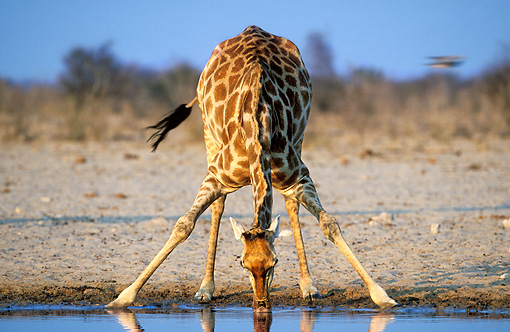
·       It is extremely dangerous to drink at a water whole as they have to spread their legs and bend down in an awkward position that makes them vulnerable to predators. Thus, the giraffe's stature can be a disadvantage, too.
 
Source: Kimballstock
·       Giraffes live primarily in savanna areas in the sub-Saharan region of Africa.

·       Typically they roam the open grasslands in small groups of about half a dozen.

·       They live up to 25 years in the wild.

·       Giraffes are listed by IUCN’s Red List as a species of least concern.
 
Source: Oak Trees US
·       They face several threats such as loss of habitat due to logging for firewood. They are also hunted for their meat, hides, and tails.

References
http://www.onekind.org/education/animals_a_z/giraffe/


Standing tall on World Giraffe Day


World Giraffe Day is annually celebrated on the 21st of June. It is an event that was started by the Giraffe Conservation Foundation to wholeheartedly celebrate the longest-necked animal on the longest day or night (depending on which hemisphere you live) of the year. 


It is a worldwide celebration of these gloriously amazing and much-loved animals. It raises awareness about their importance and why we must conserve them. It also is about learning more about the various challenges they are facing.

This year’s theme is Putting people at the centre of giraffe conservation, as chosen by the Giraffe Conservation Foundation.

Source: Express UK
Giraffe populations across Africa face many challenges, requiring unique approaches to securing their future.
Distribution of giraffes. Source: Animal Fact Guide
There are less than 90,000 giraffe remaining in the wild and serious action is needed. It is so vitally important that we secure a prosperous future for all giraffes in Africa.The message is clear: The time to act is right NOW!

Spread the message on Facebook, Twitter and Instagram with the hashtags: #Savegiraffe #WGD2017.

So, stand tall and show your invaluable support!
Source: Interesting Africa Facts

Sunday, 5 June 2016

Celebrating World Environment Day

Introduction
 

World Environmental Day is annually celebrated on the 5th of June and is the most commemorated of all the environmental awareness days in over 100 countries. In 1972 the UN General Assembly chose June 5 as World Environment Day (WED), marking the first day of the Stockholm Conference on the Human Environment. It is a platform for public outreach to stimulate and deepen global awareness of the need to care for, preserve, and enhance Mother Nature. It is a day to acknowledge and personalise environmental issues and to evoke positive environmental action amongst all people. It inspires individual and collective action to do something positive for the environment, to realise that each of us has a responsibility to protect to it from further destruction, and to take care of it indefinitely.
 
People must become environmental agents of change. Notably, it is also a day to learn more about ways that people can help to ensure the future of our planet is safe and a cleaner and greener outlook for not only themselves, but, more prominently, for future generations to make greener lifestyle choices and support sustainable and equitable development. It is also known as the ‘people’s day’ for doing something to take care of the Earth. It puts a spotlight on all the achievements and effective actions that have been implemented to protect life-nurturing Mother Nature.
 
Each year a different global country is assigned as the host of WED where official celebrations occur and this year’s host is Angola. A greater emphasis is placed on the environmental challenges that this specific country is faced with and support is provided in an effort to address them.
 
Importance of WED
As a result of decades celebrating this momentous day, millions of people from all over the world have participated in imperative environmental action. Furthermore, it is celebrated to look at all the achievements that have been made towards protecting the environment. It reminds individuals and countries of the importance of caring for our environment. It encourages societies to actively participate in becoming an agent in curbing negative environmental impacts.
 
Being a part of the celebrations, it provides an opportunity for people to share ideas and activities to make the world a better, environmentally-friendly place. As the official WED 2016 website reminds as, “Remember that every action counts, so join us: every year, everywhere, everyone!”
 
Theme
Each year a specific theme for WED is chosen by the United Nations to promote awareness on a specific and pressing environmental issue. WED 2016’s theme is: The illegal trade in wildlife under the slogan ‘Go Wild for Life’.
 
Wildlife not only faces man-made and natural threats such as climate change, habitat loss, and collisions with vehicles, but also one incredibly yet totally avoidable danger: the lucrative illegal wildlife trade. Huge profits can be made from ivory and rhino and is a very attractive commodity. This year focuses specifically on highlighting the dangers illegal wildlife trade has on our wellbeing. This illegal yet booming trade is fast eroding Mother Nature’s precious biodiversity but it is depriving us of our wonderful natural heritage. If this trade isn’t curbed swiftly, extinction is imminent. Furthermore, the killing and smuggling undermine economies and ecosystems. Through this senselessly shocking practice, elephants, rhinos, tigers, gorillas, and sea turtles are threatened. Other lesser-known species that are also negatively impacted include helmeted hornbills, pangolins, wild orchids and timbers like Rosewood. Notably, efforts to counter this illegal trade, including stronger policies, awareness campaigns and investments in community conservation and law enforcement, have occurred. But a lot can still be done.
 
It is important to convey a zero-tolerance for this illegal trade. This year all people are encouraged to celebrate those species that are under sever threat in order to take action to help safeguard them for not only current, but also future generations to come.
 
The rationale behind this year’s theme is that the illegal trade in wildlife will ultimately lead to extinction (both at a local and global scale) of many animal and plant species. The extinction of elephant, tiger and sea turtle species will be detrimental for conservation efforts. Wildlife crime is a rising threat to economies and communities, especially in developing countries. The loss of a species is a destruction of the biodiversity that supports the natural systems and on which we depend for food security, medicines, fresh air, water, shelter and a clean environment. By reducing human-wildlife conflict and, simultaneously, engaging communities in conservation efforts, there will be an increase support for wildlife protection and provide incentive to reduce poaching.
 
Facts on illegal trade on wildlife
 
·        100,000 African elephants were killed in 2010-2012, out of a population estimated at less than 
      500,000.
·        Illegal trade in wildlife is worth $15-20 billion annually, and is one of the largest illegal trades in the world.
·        Poachers in Africa killed at least 1,338 rhinos in 2015, according to the International Union for Conservation of Nature (IUCN).
·        Rhino poaching in South Africa increased by almost 9,000% or 90-fold between 2007 and 2015 from 13 rhinos killed in 2007 to 1,175 rhinos killed in 2015.
·        An estimated 170 tonnes of ivory was illegally exported out of Africa between 2009 and 2014.
·        Between 2002 and 2011 there was a 2/3 plummet in Forest Elephant population due to poaching.
·        Since 2009 there has been a 60% decline African Savannah Elephants in the United Republic of Tanzania and a 50% decline in African Savannah Elephants in Mozambique.
·       Chimpanzees are now extinct in Gambia, Burkina Faso, Benin and Togo.
·       3,000 Great Apes are lost from the wild every year and have disappeared from Gambia, Burkina Faso, Benin and Togo; over 70% of all great ape seizures are orangutans.
·       Illegal, unreported, and unregulated (IUU) fishing is estimated at 11-26 million tonnes of fish each year, worth between $10 and $23 billion, causing depletion of fish stocks, price increase and loss of livelihoods for fishermen.
·       Pangolins are the most illegally trafficked mammal in the world with over one million animals taken from the wild in the past decade.
·       40% of all intrastate conflicts in the last 60 years were linked to natural resources and over 80% of major armed conflicts in the last 50 years occurred in biodiversity hotspots.
·       In 2011, a subspecies of Javan rhino went extinct in Vietnam, while the last western black rhinos vanished from Cameroon the same year.
 (Source: Official World Environment Day 2016 website).
 
Partaking in WED Activities
WED is celebrated in various ways such as bicycle parades, concerts, poster competitions, tree planting, recycling efforts, and clean-up campaigns.
 
In terms of this year’s theme, the following can be done:
·         People need to understand the damage that illegal trade has on, not only the environment, but
       also their livelihoods, communities, and security.
·         People must change their behaviour and habits so that demand for illegal wildlife products
       declines.
·         More awareness and action will enable governments and international bodies to introduce and
       enforce tougher laws.
 
In terms of using social media as a platform to show your support, the following can be done:
·         Share all the information related to this important environmental event.
·         Encourage as many people as possible to ‘like’, ‘tweet’ or comment on WED.
·         Use hashtags #worldenvironmentday #wed2016 #wildforlife and make use of the following three
       posters:
 
  
·         More information can be obtained from: www.uneporg/wed.
·         Make use of the official logo on social media platforms:
 

·         Make use of the following official WED posters:


In general environmental-friendly terms, the following can be done:
·         Adopt an eco-friendly, sustainable lifestyle, and set green goals.
·         The smallest thing, such as recycling can make a huge difference.
·         Eat organic food.
·         Make meals only from locally grown products.
·         Leave your car and drive a bicycle or take public transport.
·         Wear green clothes to show that you care for Mother Nature.
·         Set up a recycling programme at home or the office.
·         Use reusable shopping bags.
·         Plant a tree or indigenous plants.
·         Take a nature walk and enjoy being outdoors.
·         Create your own vegetable and herb garden.
 
Important Environmental-related Quotes


·         "Take care of the earth and she will take care of you." - Author Unknown
·         "We never know the worth of water till the well is dry." - Thomas Fuller
·         "We do not inherit the earth from our ancestors, we borrow it from our children." - Native American Proverb
·         "When we heal the earth, we heal ourselves." -  David Orr
·         "The world is a fine place and worth fighting for." - Ernest Hemingway
·         “The environment is everything that isn’t me”. – Albert Einstein
·         “Never doubt that a small group of thoughtful, committed citizens can change the world; indeed, it’s the only thing that ever has”. – Margaret Mead

·         “It is horrifying that we have to fight our own government to save the environment”. – Ansel Adams
·         “I think the environment should be put in the category of our national security. Defense of our resources is just as important as defense abroad. Otherwise what is there to defend”? – Robert Redford
·         “Take a course in good water and air; and in the eternal youth of Nature you may renew your own. Go quietly, alone; no harm will befall you”. – John Muir
·         “Birds are indicators of the environment. If they are in trouble, we know we’ll soon be in trouble”. – Roger Tory Peterson
·         “If we do not permit the earth to produce beauty and joy, it will in the end not produce food, either”. – Joseph Wood Krutch
·         “Conservation is a state of harmony between men and land”. – Aldo Leopold
·         “People blame their environment. There is only one person to blame – and only one – themselves”. – Robert Collier
·         “The only way forward, if we are going to improve the quality of the environment, is to get everybody involved”. – Richard Rogers
·         “Journey with me to a true commitment to our environment. Journey with me to the serenity of leaving to our children a planet in equilibrium”. – Paul Tsongas
·         “Earth Day 1970 was irrefutable evidence that the American people understood the environmental threat and wanted action to resolve it”. – Barry Commoner
·         “The most important environmental issue is one that is rarely mentioned, and that is the lack of a conservation ethic”. – Gaylord Nelson
 
Conclusion
Please keep your world clean and green. Earth is the only liveable planet, help save it for future generations, and abide by environmental laws. The need for change is pressing because if something isn’t seriously done to protect species, extinction will be imminent. The responsibility lies with all of us to take immediate action. So, make a difference - the time to act is now! Take a step in the green direction. Remember, Every Day should be World Environment Day!
 
 
References