
Coral
reefs
 |
| Source: Genetic Literacy Project |
 |
| Source: From the Grapevine |
There is no doubt: Coral reefs are some of
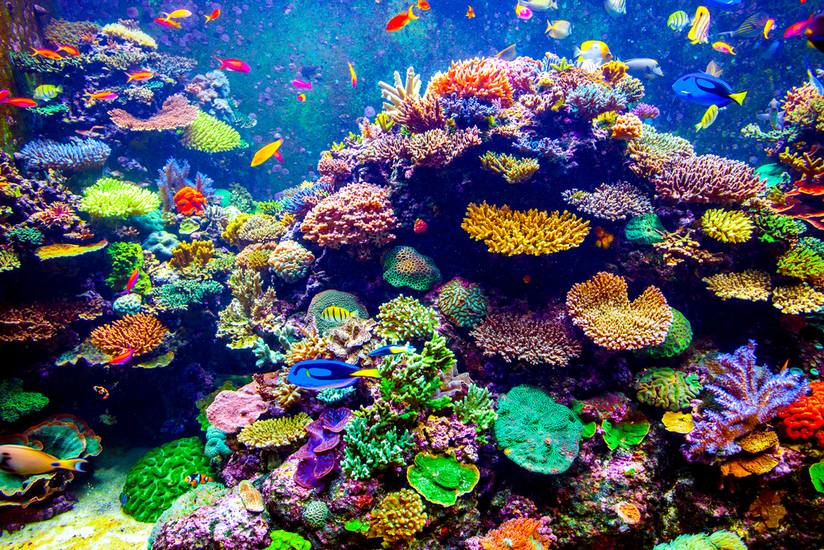
the most stunning places on Earth and colourful and diverse ecosystems. Though the
total area of the world's coral reefs amounts to less than one quarter of 1% of
the entire marine environment, they have a huge effect on the health of the
rest of the world (Mother Nature Network). Coral reefs are extremely important
to life in the ocean. Healthy coral reefs mean healthy oceans which means
healthy planet (Mother Nature Network). The variety of life supported by coral
reefs rivals even that of the Amazonian or New Guinea tropical forests. Coral
reefs are among the most biodiverse ecosystems on the planet (Darling and
Fraser 2013) as they are home to tens of thousands of marine species. In fact,
they are second only to rainforests in biodiversity of species. They cover less
than 0.2% of our oceans but contain 25% of the world's marine fish species!
Interestingly, although coral reefs are kind of like an enigma as they are
among the most flourishing ecosystems on Earth, and they support high diversity
and high biomass, yet they achieve this in some of the least fertile waters on
Earth.
Defining
Coral Reefs
Geologically speaking, reefs can be
defined as “masses of carbonate limestone, built up from the sea floor by the
accumulation of the skeletal material of many coral reef plants and animals”.
They can also be described as “diverse underwater ecosystems held together by
calcium carbonate structures secreted by corals”. Corals are not plants - they're actually
ancient animals and are relatives of jellyfish and anemones. They are built by
“colonies of tiny animals found in marine waters that contain few nutrients.
Most coral reefs are built from stony corals, which in turn consist of polyps
that cluster in groups”. Corals are simple, clonal invertebrates that serve as
ecosystem engineers, building living structures (reefs) so large that they can
be seen from space (Burkepile and Hay 2008). It is important to note that a
coral reef mustn’t be seen as a “biome” or “ecosystem”, but rather like a
living community.
There are three types of reefs:
 |
| Source: Marinebio.net |
· Fringing
reefs occur along shorelines of continents and islands. It is commonly found in
Hawaii and the Caribbean. It gets its name from being closer to shore than a
barrier reef. They are arranged like a fringe around the shallow waters.
 |
| Source: Wikipedia |
 |
| Source: Britannica |
 |
| Source: Ducati Performance Parts |
Range and Location
 |
| Source: NOAA CoRIS |
Coral reefs cover more than 250,000 km2
of the ocean (all of them in the world add up to less than one per cent
of the sea floor – an area about the size of France). Coral reefs are found all
around the world in clear, tropical and subtropical oceans, and even in
unexpected places have discovered cold water coral reefs off the coast of
Norway and deep underwater in the Mediterranean Sea. The greatest diversity of
species occurs in the Indo-Pacific region and a second, less diverse, region
centred on the western Atlantic. One third of the world's coral reefs are
located in South East Asia, hosting some of the highest levels of marine
biodiversity on Earth. Coral reefs need water that is between 68 - 82°F (20 -
28°C), which is often located along the eastern shores of land. Corals live
normally close to the surface where the sun's rays can reach the algae. They are typically found in shallow areas at a depth
of less than 150 feet because they need
sunlight to survive. But, some coral reefs can extend even deeper (up to about
450 feet deep).
Large coral reefs are rarely found in
areas above 29 latitude where ocean temperatures fall below 18oC for
extended periods as this slows coral growth and their capacity to build large
reefs (Burkepile and Hay 2008). Reefs are abundantly found in areas with
shallow coastlines and clear, warm water where riverine discharge of sediments
is low (Burkepile and Hay 2008). The most biologically diverse reefs occur in
the tropical Indo-Pacific in the areas around Indonesia and the Philippines and
house over 550 species of coral and thousands of species of fish (Burkepile and
Hay 2008). The Great Barrier Reef off north-eastern Australia is the largest
reef in the world with more than 2800 individual reefs occupying over 1800 km
of the Australian coastline and can be seen from outer space (Burkepile and Hay
2008).
Diet
An individual coral (polyp) is a small
organism consisting largely of a stomach topped by a tentacle-bearing mouth. These polyps extend their tentacles at night to sting
and ingest tiny organisms (plankton) and other small creatures. Reefs only
occur in shallow areas that are reachable by sunlight as a result of their
relationship with algae. Many types of microscopic algae (Symbiodinium) live
inside of the coral and provide them with food and help them to grow faster. In many ways, reef-building corals are animals that
act like plants – they stay in one place and get some of their energy from the
sun. Corals get most of
their nutrients from the by-products of the algae's photosynthesis. But they
also have barbed, venomous tentacles they stick out, usually at night, to grab
zooplankton and even small fish.
Behaviour
They usually develop in areas that have a
lot of wave action as the waves bring in food, nutrients and oxygen to the
reef. Waves prevent sediment from falling on the reef. Reefs need calcium from
the water to grow, which is often only available in shallow warm waters.
Importance
of Coral Reefs
Coral reef ecosystems are important for
many reasons:
·
Coral
reefs are among the most biologically diverse and economically important
ecosystems on the planet. Corals provide valuable and vital ecosystem services.
They act as home and nursery grounds for many economically important marine
species, protect coastlines from erosion, and provide food sources and income
to millions of people living along coastlines (Zvulonic et al 2015). It provides immense ecological and economic benefits
that contribute to the welfare of millions of people (Darling and Fraser 2013).
They provide services that are vital to human societies and industries through
fisheries, coastal protection, building materials, new biochemical compounds,
and tourism.
·
They
not only provide incredible value as wildlife habitat, but also protect
coastlines from storms. Moreover they provide billions of dollars of food and
jobs every year to people around the world.
·
They
form the nurseries for about a quarter of the ocean's fish - including
commercially important species.
·
The
biodiversity translates directly into food security, income, and a multitude of
other benefits to people.
· Coral
reefs play an important role in the survival of our planet because it not only
directly supports a marine ecosystem, but it also provides important benefits
for mankind.
·
For
several coastal areas, coral reefs are also able to provide an important
barrier against storms, hurricanes, and typhoons.
·
Reefs
assist also in being nurseries for large fish species, keeping them safe until
they are large enough to strike out into the deeper ocean. A myriad of animals use coral reefs either as a
stopping point (like an oasis) as they travel the deep blue sea, or they live
as residents at the reef.
·
Coral
reefs are vital for ocean and human health as well as our wellbeing.
·
Corals
are tiny organisms (polyps) that attach themselves to the hard reef and live
there indefinitely.
·
Coral
reefs are valuable to the fishing and tourism industries, as well as protecting
shorelines from storm damage.
·
Reefs
are an important location for finding food, shelter, mates and places to
reproduce.
·
They
remove and recycle carbon dioxide (a gas that contributes to global warming).
·
They
protect land from harsh weather by absorbing the impact from strong waves and
storms.
·
They
provide food, for example, lobster and conch. Coral reefs are also a huge tourist
attraction.
·
Coral
reefs are a large source of biodiversity.
·
Without
the reef, many of these plants and animals would die.
·
Coral
reefs are a useful educational tool as people can learn more about biomes and
ecosystems, and the interrelationship between organisms and their environment
by studying these coral reefs.
·
Particularly,
fish, invertebrates, algae and microorganisms – make their homes on and around
reefs.
·
A
coral colony is formed when thousands of identical polyps live together.
Threats
Roughly one-quarter of coral reefs worldwide are already considered damaged beyond repair, with another two-thirds under serious threat (WWF). Scientists have predicted that in the next 50 years many of the coral reefs on Earth will be gone. We have already lost 27% of the world's coral reefs and if present rates of destruction continue, 60% of the world's coral reefs will be destroyed over the next 30 years. Reefs often recover from acute disturbances such as storms but infrequently recover from chronic disturbances. The coupling of acute natural disturbances with chronic anthropogenic disturbances often leads to precipitous declines in coral reef health (Burkepile and Hay 2008; Zvulonic et al 2015).
There are many problems facing not only coral reefs but also their habitats today. Coral reefs around the world have been declining at an alarming rate due to increasing human impacts. Despite the significance of coral reefs, these wildlife habitats are imperiled throughout the world. Sadly, fragile coral reefs that are already under increasing pressure associated with a range of natural and human causes has resulted in substantial degradation. This has ultimately led to a loss of coral cover and shifts in community structure. It should be noted that the impacts of these events have varied spatially and taxonomically. Even some of the most remote and pristine reefs are losing species. An estimated 75 per cent of remaining coral reefs are currently threatened. They are subject to many terrestrial, atmospheric, and oceanic influences. Many of these are directly related to human activities. Over the past years, losses and changes of marine biodiversity in coral reef ecosystems by anthropogenic activities, natural phenomena, and poor land management practices have become urgent issues (Zvulonic et al 2015). Coral reefs are also one of the most vulnerable ecosystems to climate change (these rapid environmental changes are occurring against a background of other widespread human-induced disturbances (anthropogenic activities) such as overexploitation, destructive fishing practices which removes species with important ecological functions, coastal runoff, coastal development, pollution, climate change, ocean acidification, unsustainable tourism, and invasive species, which may ultimately stress corals to the brink of extinction (Darling and Fraser 2013; Zvulonic et al 2015; Burkepile and Hay 2008). Reefs located near human population centres are subjected to multiple stresses simultaneously and so suffer losses in diversity and cover. Meeting local demands can have multiple negative effects on the local environment. More than half of the world’s coral reefs are faced with high levels of human activities. The cumulative impacts of local and global stressors have resulted in widespread losses of live coral cover and an elevated risk of extinction to one-third of all reef-building corals. The loss of healthy reefs may therefore limit the protection they can provide to coastal communities. The concept of resilience now underpins much of the thinking about the management of coral reefs (Darling and Fraser 2013).
Notably, coral reef ecosystems are particularly sensitive to climate-induced changes in the physical environment. Coral reef communities are likely to change in the future as reef organisms respond differently to various stressors. In order to predict future reef compositions, we apply estimates of coral and fish vulnerability to two key stressors; climate change (bleaching) and fishing. Most corals were vulnerable to one or both stressors, and future coral communities are likely to comprise stress-tolerant and weedy life histories (McClanahan et al 2014). Over the past 150 years, sea surface pH has dropped by 0.1 units and sea surface acidity has increased by 26% (Darling and Fraser 2013). Ocean warming and acidification are only two of the many manifestations of climate change. Other potential influences include sea level rise and changes in storm regimes caused by warmer SSTs (Darling and Fraser 2013).
There are many problems facing not only coral reefs but also their habitats today. Coral reefs around the world have been declining at an alarming rate due to increasing human impacts. Despite the significance of coral reefs, these wildlife habitats are imperiled throughout the world. Sadly, fragile coral reefs that are already under increasing pressure associated with a range of natural and human causes has resulted in substantial degradation. This has ultimately led to a loss of coral cover and shifts in community structure. It should be noted that the impacts of these events have varied spatially and taxonomically. Even some of the most remote and pristine reefs are losing species. An estimated 75 per cent of remaining coral reefs are currently threatened. They are subject to many terrestrial, atmospheric, and oceanic influences. Many of these are directly related to human activities. Over the past years, losses and changes of marine biodiversity in coral reef ecosystems by anthropogenic activities, natural phenomena, and poor land management practices have become urgent issues (Zvulonic et al 2015). Coral reefs are also one of the most vulnerable ecosystems to climate change (these rapid environmental changes are occurring against a background of other widespread human-induced disturbances (anthropogenic activities) such as overexploitation, destructive fishing practices which removes species with important ecological functions, coastal runoff, coastal development, pollution, climate change, ocean acidification, unsustainable tourism, and invasive species, which may ultimately stress corals to the brink of extinction (Darling and Fraser 2013; Zvulonic et al 2015; Burkepile and Hay 2008). Reefs located near human population centres are subjected to multiple stresses simultaneously and so suffer losses in diversity and cover. Meeting local demands can have multiple negative effects on the local environment. More than half of the world’s coral reefs are faced with high levels of human activities. The cumulative impacts of local and global stressors have resulted in widespread losses of live coral cover and an elevated risk of extinction to one-third of all reef-building corals. The loss of healthy reefs may therefore limit the protection they can provide to coastal communities. The concept of resilience now underpins much of the thinking about the management of coral reefs (Darling and Fraser 2013).
Notably, coral reef ecosystems are particularly sensitive to climate-induced changes in the physical environment. Coral reef communities are likely to change in the future as reef organisms respond differently to various stressors. In order to predict future reef compositions, we apply estimates of coral and fish vulnerability to two key stressors; climate change (bleaching) and fishing. Most corals were vulnerable to one or both stressors, and future coral communities are likely to comprise stress-tolerant and weedy life histories (McClanahan et al 2014). Over the past 150 years, sea surface pH has dropped by 0.1 units and sea surface acidity has increased by 26% (Darling and Fraser 2013). Ocean warming and acidification are only two of the many manifestations of climate change. Other potential influences include sea level rise and changes in storm regimes caused by warmer SSTs (Darling and Fraser 2013).
Although biotic interactions (e.g.,
competition and herbivory) are emphasized as having important consequences for
coral reef structure, abiotic disturbances such as hurricanes, temperature
fluctuations, sedimentation stress, and sea-level change also produce
long-lasting effects on reefs (Burkepile and Hay 2008).
Coral Bleaching
Coral bleaching is rapidly becoming a global concern. Abnormally high ocean temperatures are being observed more frequently, and these temperatures could lead to mass bleaching event. Over the past century, average global sea surface temperatures (SSTs) have
risen by 0.6 C and temperature anomalies, i.e., deviations from long-term
temperature averages, are occurring more frequently (Darling and Fraser 2013). Furthermore,
bleaching is caused by elevated sea surface temperatures, low temperature,
sedimentation, extreme salinities or light levels, or bacterial infection.
 |
| Coral Bleaching - before and after. Source: New Heaven Dive School |
Rising seawater temperature due to
climatic changes is an extremely serious and global cause of stress to corals.
When temperatures are too high, the relationship between corals and their
symbiotic microalgae unfortunately breaks down. The algae are responsible for
giving corals their mesmerizingly bright colour but when this occurs, corals
appear white (“bleached”). Coral bleaching occurs when corals degrade or expel their dinoflagellate symbionts in response to environmental stressors such as elevated sea surface temperature and increased UV radiation. Just one degree above the typical summer max can
cause corals to become bleached. What is more is that if the temperature is too
high for too long, corals (and their microalgae) are unable to recover. Over
the last couple of decades, bleaching has become more frequent, intense, and
widespread which has ultimately led to massive, global die offs of corals (Burkepile and Hay 2008).
 |
| Source: Atlas Obscura |
In severe cases, bleaching may occur on the scale of hundreds
to thousands of kilometers and radically alter coral cover and composition with
coral mortality from bleaching events approaching 100% in extreme cases
(Burkepile and Hay 2008). Large-scale bleaching and mortality of branching
corals can suppress fish populations that are dependent on live coral for
shelter and food (Burkepile and Hay 2008). Moreover, due to warmer oceanic
temperatures, there are more disease-related problems as these
high-temperatures allow corals to become sick more easily, and allow
disease-causing organisms to grow faster.
Ocean
Acidification
 |
| Source: Sound Waves Monthly Newsletter - US Geological Survey |
Ocean acidification is another serious
threat to coral reefs. Because carbon dioxide (CO2) is more frequently released
into the atmosphere and it has adverse effects on the oceans. Some of the
excess CO2 from the atmosphere is absorbed by seawater which ultimately cases
the oceans to become more acidic. Shockingly, the oceans’ acidity has increased
by 25 per cent over the past 200 years. Consequently,
these acidic conditions dissolve coral skeletons (which make up the structure
of the reef) and limit coral to grow effectively. If something isn’t done,
scientists estimate that the oceans could become 150 per cent more acidic by
the end of this century. This will mean that corals will have a hard time to
grow.
Fishing
 |
| Source: NOAA National Ocean Service |
Coral reefs are negatively impacted by
destructive fishing and exploitation to supply the coral reef wildlife trade.
Frequently poisons (e.g. cyanide) are dumped into the water in order to stun
fish to easily catch them. Sadly, it not only kills fish, but also corals,
other forms of wildlife. This also leads to degrading the reef habitat.
Overfishing affects the ecological balance of coral reef communities
negatively, warping the food chain.
Sediments
Sediments, nutrients, and toxins released
from deforestation, agriculture, and industry, are hydrologically transported
to coral reefs through local rivers which ends up in the ocean, where it can
'smother' corals by depriving them of the light needed to survive.
Pollution
 |
| Source: NOAA National Ocean Service |
Urban and industrial waste, sewage,
agrochemicals, and oil pollution are unfortunately
poisoning reefs as it is dumped directly into the ocean or carried by river
systems from sources upstream. Sewage and runoff from farming increase nitrogen
levels in seawater which causes an overgrowth of algae, ‘smothering’ reefs by
cutting their sunlight off.
Climate change
 |
| Source: NOAA National Ocean Service |
Climate change is an unprecedented threat. Corals cannot survive if the water
temperature is too high. Unfortunately, global warming has already led to
increased levels of coral bleaching and will increase in frequency and severity
in the next few decades. Climate change is fundamentally altering ocean chemistry. Approximately one-third of atmospheric CO2 emissions are absorbed by the oceans and dissolve to reduce ocean pH, effectively increasing the acidity of seawater (Darling and Fraser 2013). If even the conservative predictions of global climate models are realized, these climate changes could result in the fundamental reorganization of the ecology of coral reefs (Burkepile and Hay 2008).
Resilience
Resilience is a measure of the persistence
of systems and of their ability to absorb change and disturbance, and still
maintain the same relationships between populations or state variables.
Ecosystems are dynamic, spatially and temporally heterogeneous, and can exist
in multiple alternative states depending on environmental conditions. An
ecosystem may be resilient for two reasons. On the one hand, an ecosystem may
be resistant to a given perturbation. Carpenter et al. (2001) defined
resistance as the amount of external pressure needed to bring about a given
amount of disturbance in a system. On
the other hand, two ecosystems may have similar resistance to a given
perturbation, but may differ in their potential for recovery, that is their
ability and/or swiftness to return to a state that is functionally similar to
the pre-disturbance state (Darling and Fraser 2013).
Crazily
cool facts about Coral Reefs
·
The Great Barrier Reef in Australia is the largest living thing on the planet.
 |
| Source: Science |
 |
| Source: WWF |
· Reefs
that are noticeable in size (like the aforementioned reef) are between 5 and
10,000 years old.
·
The
Great Barrier Reef comprises of 900 smaller reefs! It covers about 1,200 miles (1900
km) and crosses over 500 islands. Unsurprisingly, it is one of the most visited
reefs in the world, and, judging by the pictures below, one can easily see why:
 |
| Source: Serge the Concierge |
·
The
shape of a coral reef forms a natural protective barrier against storm waves
and the waves break apart on the reef, so they don’t hit the shore at full
force. A reef is called a “barrier” when its presence is able to protect the
shallow waters along the shore from the open sea, thereby protecting and
promoting the survival of several sea plants and animal life.
·
A
coral reef is a community of life that lives and thrives in one location.
·
Interestingly,
what we think of as the base of the reef and what we see when it is dry and
removed from the water are only one small aspect of a living reef!
·
Various
fish and sea creatures choose to spawn in reefs as their eggs will be safe from
predators.
·
Coral
reefs assist in improving the nearby water quality as they act as a filter,
trapping things floating in the water, which makes for cleaner water all
around.
·
Reefs
essentially grow where there are stronger wave patterns and currents as it delivers
more food for the ecosystem that creates the reef structure.
·
A
coral reef needs sunlight to grow and, thus, they hardly ever grow in waters
deeper than 45 feet.
·
Corals
can be an assortment of colours, white, red, pink, green, blue, orange, and
purple, due to natural pigments and the zooxanthellae in their tissues.
·
They
also are more likely to be found in tropical oceans, as the water is clearer
and warmer.
·
Coral
reefs provide a space for feeding and raising babies for many of the sea
mammals because the coral reef can stabilize the seabed for seagrasses.
·
Coral
reefs play an imperative role in helping to manage carbon monoxide levels.
·
Wherever
coral reefs grow, the sea bed is more stable and it helps seagrass and other
sea plants to survive in the area. The more plants are growing on the sea bed,
the less impact storms and surges will have on seabed too.
·
Coral
reefs are found in 109 countries but significant reef degradation has occurred
in 93 countries.
·
More
than 80% of the world's shallow reefs are severely over-fished.
·
Southeast
Asia is the global epicentre of marine diversity: Its 100,000km2 of
coral reefs (34% of the world's total) are home to over 600 of the 800
reef-building coral species in the world.
·
Indonesia
and the Philippines hold 77% of Southeast Asia's coral reefs and nearly 80% of
threatened reefs.
·
All
corals have been listed under Appendix II of the Convention on International
Trade of Endangered Species (CITES) since 1990.
·
More
than 450 million people live within 60 kilometres of coral reefs, with the
majority directly or indirectly deriving food and income from them.
·
There
can be as many different types of fish in two acres of coral reef in Southeast
Asia as there are species of birds on the entire continent of North America.
·
Corals
are related to i.e. sea anemones and sea jellies. They make use of their
tentacles for defence and to capture their prey.
Conclusion
Coral reefs have survived tens of thousands of years of natural change, but without urgent action to address threats, these beautiful and life-sustaining organisms could disappear, and their survival would be unknown.
References
Coral reefs have survived tens of thousands of years of natural change, but without urgent action to address threats, these beautiful and life-sustaining organisms could disappear, and their survival would be unknown.
References
Burt,
J.A., Coles, S., van Lavieren, H., Taylor, O., Looker, E., & Samimi-Namin,
K. 2015. Oman's coral reefs: A unique ecosystem challenged by natural and
man-related stresses and in need of conservation. Marine
Pollution Bulletin.
Burkepile,
D.E. & Hay, M.E.2008. Coral Reefs. Elsevier B.V.
Chavanicha,
S., Soong, K., Zvulonic, A., Rinkevichd, B., Alinoe, P.2015. Conservation,
management, and restoration of coral reefs. Zoology 118 p. 132–134.
Darling,
E.S. & Cote, I.M. 2013. Vulnerability of Coral Reefs.
McClanahan,
T.R., Graham, N.A.J., & Darling, E.S. 2014. Current Opinion in Environmental Sustainability 7:59–64.
Websites
Mother
Nature Network. Fascinating Facts about Coral Reefs. http://www.mnn.com/earth-matters/animals/blogs/5-fascinating-facts-about-coral-reefs


